Commercial AC Installation: A Complete Guide for Businesses
Commercial AC installation involves a load calculation to determine system size, equipment selection based on building type and use, ductwork design or modification, permitted installation by a licensed contractor, and commissioning to verify performance. The process typically takes one to five days depending on building size and system complexity.
When a commercial AC system fails during business hours, the cost isn’t just the repair bill. It’s customers who leave, employees who can’t work, and for food service businesses, product that can’t be stored. Commercial AC installation is one of the larger capital decisions a business owner makes and deserves a structured approach. This guide covers what the process involves so you know what to expect before any work starts.
Commercial AC vs Residential: What’s Actually Different
Commercial systems handle larger spaces, higher occupancy loads, and more complex heat sources than anything a residential system is built for. Kitchen equipment, server rooms, and commercial lighting all add significant heat load that a load calculation has to account for. Equipment is heavier, higher tonnage, and in most Clay County commercial buildings it’s roof-mounted rather than sitting on a ground pad beside the building.
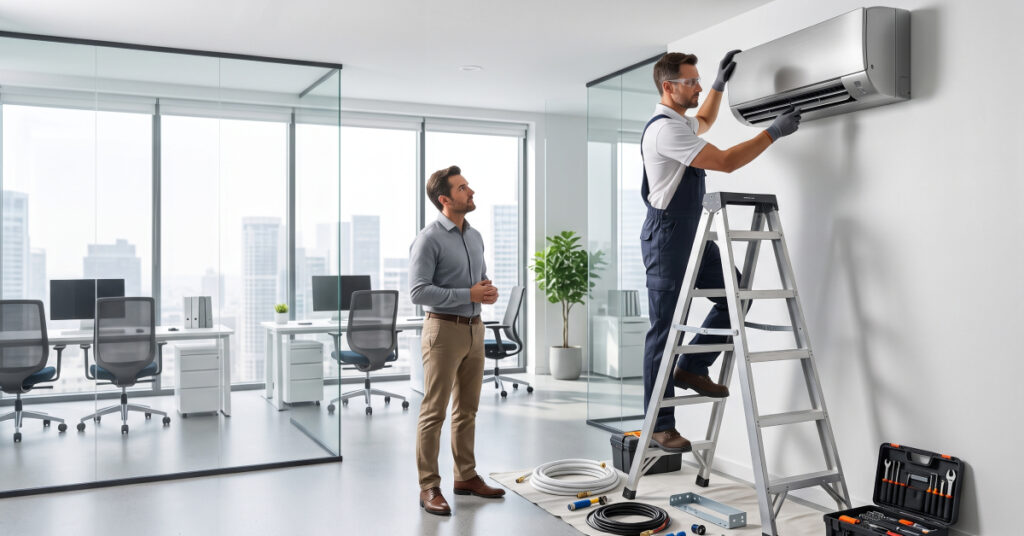
Commercial installation also involves zoning requirements, building permits in most Florida jurisdictions, and coordination with other building systems. Skipping any of those steps creates problems that show up later, usually at the worst possible moment. That’s why the contractor choice matters more on a commercial job than a residential one.
Step 1: The Load Calculation
The load calculation is where a commercial AC installation either gets done right or gets done wrong. It’s a mathematical assessment of how much cooling capacity the building actually needs, accounting for square footage, ceiling height, insulation, occupancy patterns, equipment heat loads, window exposure, and local climate data. In Clay County, the cooling load is significantly higher than a national average because of humidity levels and the length of the cooling season. A system sized for a generic Southeast average won’t perform correctly in a Middleburg summer.
An oversized system short cycles, never removes enough humidity, and wears out the compressor early. An undersized system runs continuously and still can’t reach setpoint on a hot afternoon. Any contractor who quotes without running a load calculation is guessing at the number your business depends on.
Step 2: Choosing the Right Commercial AC System
Rooftop Package Units
The most common system for single story commercial buildings in Northeast Florida. The entire unit sits on the roof and connects to interior ductwork below. Easy to service without disrupting the building interior, which matters for restaurants and retail spaces where downtime costs money. Most Clay County retail, restaurant, and small office properties use rooftop package units.
Split Systems and Multi Zone Systems
Split systems separate the outdoor condenser from the indoor air handler, useful where rooftop mounting isn’t practical. Multi-zone systems run one outdoor unit to multiple independent indoor air handlers, which works well for buildings with areas that have very different cooling requirements. A server room and an open retail floor on the same circuit is a problem a multi-zone system solves cleanly.
On efficiency: commercial systems carry SEER ratings, and in Florida’s year round cooling climate a higher efficiency unit pays back its premium faster than in a seasonal market. Run the numbers on operating cost before deciding the higher-rated unit isn’t worth it.
Step 3: Ductwork, Permits, and What They Cover
New commercial AC installation usually means modifying existing ductwork or designing a new distribution system. How the ducts are laid out determines how evenly the building gets cooled. A system with poor duct design will overcool some areas while leaving others uncomfortable regardless of how good the equipment is. Getting the ductwork right is part of the installation, not an afterthought.
Commercial HVAC installation in Florida requires permits. A contractor who suggests skipping them is telling you something about how they work. Permitted work gets inspected and verified to meet code. Unpermitted work creates liability for the building owner, not the contractor.
Step 4: Installation and Commissioning
Once equipment is on site, installation covers positioning the unit, running and connecting refrigerant lines, making and verifying electrical connections, connecting and sealing ductwork, and installing the thermostat or building control system. Larger rooftop units require crane placement. Commissioning comes after installation: the system is run, airflow is measured and balanced, refrigerant charge is verified, and performance is confirmed against the load calculation before the contractor signs off.
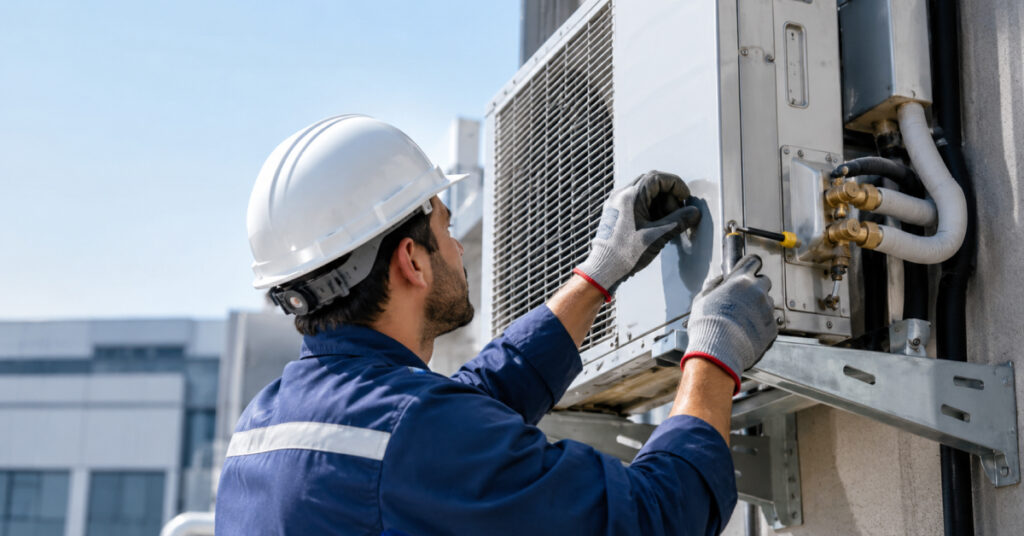
Timeline depends on the building. A single rooftop unit on a small Clay County retail space can be done in one day. A multi zone system across a larger property is a multi day project. No firm timeline exists before a site assessment.
Questions to Ask Before Hiring a Commercial HVAC Contractor
Ask whether the contractor runs a full load calculation before recommending equipment or quotes from square footage alone. Ask whether permits and inspections are included in the scope. Ask who commissions the system after installation and what that process verifies. Ask whether the technicians are licensed in Florida with commercial system experience. And ask whether technicians work on commission or sales incentives. Patriot Climate Solutions’ technicians don’t. They’re not bonus incentivized to sell parts or equipment you don’t need. That matters on a commercial job where the invoice can be significant and the pressure to add scope is real.
Frequently Asked Questions
How long does a commercial AC installation take in Clay County?
A single rooftop unit on a small commercial space typically takes one day. Larger or multi zone systems across bigger buildings run two to five days. The accurate answer depends on a site assessment, not a phone estimate.
How often should a commercial AC system be serviced after installation?
Twice yearly is the standard for Clay County commercial properties running year-round. Spring before peak cooling season and fall after it. Commercial systems in food service or high occupancy environments may need quarterly filter service in addition to twice-yearly full maintenance visits.
Can I replace just the outdoor unit on my commercial system?
Sometimes, but not always. Mismatched equipment reduces efficiency and can void warranties. A licensed technician needs to verify compatibility between the existing indoor components and the proposed replacement unit before that decision is made.
Commercial AC Installation Done Right
Commercial AC installation is a process, not a quick transaction. The load calculation is the foundation. Equipment selection follows from it. Proper ductwork, permitted installation, and commissioning are where it either gets done correctly or gets done cheap. The difference shows up clearly in your energy bills and your system’s lifespan within the first two years of operation. Patriot Climate Solutions handles commercial AC installation across Middleburg, Orange Park, Green Cove Springs, and Clay County with load calculations, permitted work, and no commission driven upsell. Call (904) 505-0183 to schedule a commercial assessment.